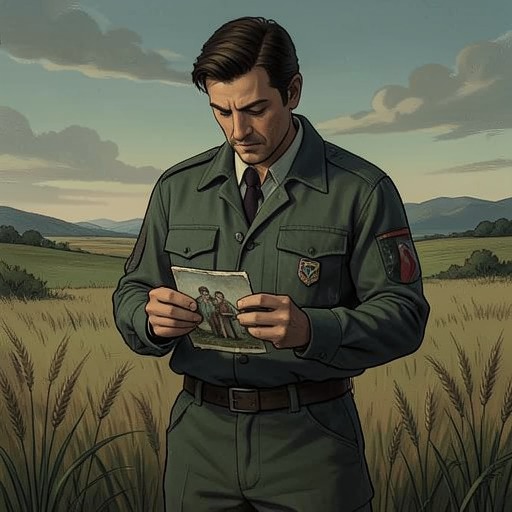
Fascist repression in Valladolid
For Whom the Bell TollsFascist repression in Valladolid appears through the losses Joaquín recounts to his companions: his parents and two brothers-in-law were killed, one sister was shot, and another remained imprisoned. His account makes the village massacre and its arguments over revolutionary violence part of a wider pattern of persecution, while also showing how intimate family testimony resists easy distinctions between justice, necessity, and vengeance.
The Family’s Losses
When Joaquín identifies Valladolid as his home, he names the relatives killed there: his father, mother, brother-in-law, and sister. Asked how the family had been targeted, he explains that the authorities shot his father because he had voted Socialist, and his mother because she had also voted that way. It was the first time she had voted. The account gives the parents’ political affiliation immediate and personal consequences: even a single act of voting becomes grounds for execution.
The persecution extended to the women’s husbands, though Joaquín distinguishes their circumstances. One brother-in-law belonged to the tramway drivers’ syndicate, but, as Joaquín stresses, was not politically active. He describes him as no great comrade, underscoring that political commitment was not required for the family’s vulnerability. The other sister’s husband had gone to the hills. The authorities believed she knew where he was; Joaquín says she did not, but they shot her because she would not tell them where he had gone.
The family’s survival is reduced to a few uncertain remnants. Joaquín says his remaining sister is in prison and, so far, appears not to be badly mistreated. The brother-in-law who fled to the hills may be dead. Joaquín says there is no one else in the family beyond himself. The restrained report makes imprisonment and uncertainty part of the same continuing loss as the confirmed deaths.
Repression in the Wider War
Joaquín’s testimony enters a conversation about Valladolid, not a detached account of policy. He calls it a fine town and grieves that its good people have suffered in the war; his disclosure that his family was among them arrives abruptly, prompted by the mention of his home. Robert Jordan recognizes the pattern in the way survivors struggle to name a dead parent or sibling. The personal account thus becomes one instance of a loss repeatedly carried into the present by those who have survived it.
The episode also places Valladolid alongside the village where Pablo’s band seized local Fascists before attacking the Civil Guard barracks. Pablo had arranged the capture of the Fascists in their homes at the same time as the barracks assault, preventing them from attacking the band from behind. The contrast matters: the organized seizure of opponents is followed by a public killing that does not remain under control. The novel does not equate Joaquín’s account of executions with every act committed in retaliation, but it situates the village violence within a war already marked by political persecution and bereavement.
Revolutionary Justice and Its Limits
Anselmo’s reflections sharpen the moral problem. He regards killing a person, even a Fascist, as a sin, although he has killed and expects that he may have to kill again. He imagines a different form of justice for bishops and property owners: make them work as ordinary people do, so they might learn from shared conditions rather than be killed. Robert Jordan counters that sparing enemies risks allowing them to enslave others again. Anselmo rejects both extermination and prison as answers, arguing that killing breeds further hatred and that imprisonment does the same.
Pilar’s memory of the village executions places this disagreement against the event’s actual progression. She considers the killing of the Civil Guard ugly but at first accepts it as necessary to win and preserve the Republic. She also initially understands the plan for the townspeople to share responsibility for judging and killing the Fascists. Yet the crowd’s violence departs from that conception: after Don Guillermo is attacked, sober participants withdraw, drunkards take their places, and the ordered lines become a mob. The repression recalled by Joaquín makes the stakes of resistance unmistakable; Pilar’s account shows how a response framed as justice can itself collapse into uncontrolled violence.
Memory and Moral Judgment
The story of Valladolid reaches the group as an act of testimony. Joaquín begins with the bare fact of his family’s deaths, then supplies the sequence and circumstances that explain how different relatives were targeted. When he apologizes for speaking about family matters, Maria replies that her own suffering is already so great that his account cannot add to it. The exchange treats grief not as a private interruption of wartime conversation but as something comrades can witness and make room for.
Robert Jordan’s later thoughts connect this history of political violence with the violence of the village massacre. He considers how people on both sides have done dreadful things, yet struggles with the difference between acts committed through ignorance and acts he sees as deliberate. His reflections resist a clean moral settlement: understanding might seem to invite forgiveness, but he doubts that forgiveness can simply erase what has been done. Valladolid therefore remains more than a setting for Joaquín’s grief. It is a remembered ground of political repression that informs the characters’ arguments about killing, responsibility, and whether resistance can preserve the Republic without reproducing the violence it opposes.